







We all are aware of the importance Engine oil holds for our motorcycles, but to what extent the damage could be done to the engine if we run short of engine oil must also be known so that we should remain extra careful. Let’s talk about the implications of running our motorbike engines dry or at low engine oil levels.
Knowing the fact that low engine oil levels can be fatal for the engine, the engine oil pressure sensor comes very handy, But the bitter truth is not all two wheelers come featured with this piece of technology, therefore we still have to rely on our instincts and have to be vigilant as far as monitoring the engine oil levels in our rides are concerned. When we talk about our instincts every biker knows how to communicate with his/her ride. Often when the engine starves for the fluids the roughness starts augment and one can feel the heaviness in the engine, the transmission also becomes clunky and chattering sound becomes audible.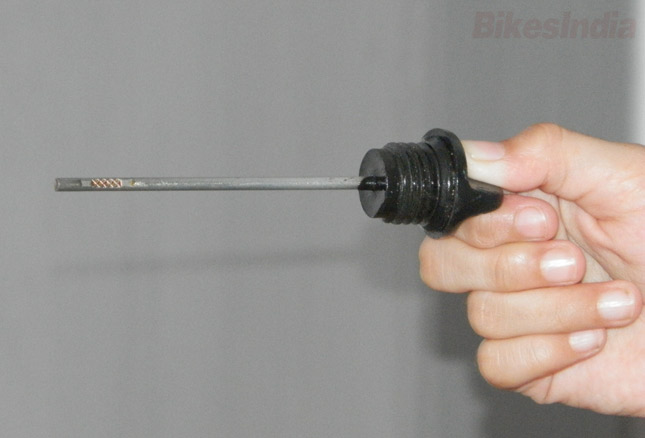 The best way to keep an eye on the engine oil level is by regularly checking the oil level through the oil gauge. The gauge is a dip stick that dips into the oil pan present at the bottom of the engine where the engine oil lies. Now, the random check of the oil level is fine but that won’t give you the accurate feedback, to get more accurate info, one has to check the oil when the engine is not hot and all the oil remains at the oil pan. Another thing that must also be considered important while checking the engine oil level is: never check the level while the motorcycle is resting on the side stand or leaned on either sides. The best is to engage the center stand or rest the motorbike on paddock stand or simply hold the bike upright and take the reading.
On the dip stick normally there are two markings available at the extreme end, one depicting low and the other showing high level. The normal reading can be considered which comes somewhere in between these two marks. If you find the engine oil level below the “Low” marking or even at it, consider its time to top up with fresh engine oil to the normal marking. Avoid filling engine oil above the “High” level because it may also create problem by seeping into the combustion chamber via bearing or valve present at the cylinder.
The majority of the engine oil serves the duty at the Cylinder Head and at the Block Piston where all the moving parts including piston, rocker arms, camshafts, cam followers and push rods are moving at a very high speed. The engine oil is either squirt on these moving parts on regular intervals or they are simply dipped into it to provide maximum lubrication and hence greater protection against any wear.
RELATED ARTICLE: What Could Cause Low Engine Oil Level
Normally it is seen that the Piston and the Connecting rod are the first to get affected by the scarcity of engine oil. The gap between Piston and the Cylinder remains very low, in fact in brand new engines the gap is fixed in such a manner that even after Piston expansion there should be enough space left for the movement. Still the piston remains in contact with the cylinder walls all the time and hence required thin film of oil for lubrication throughout. Imagine, a brand new engine which has comparatively tighter fitting Piston if runs without engine oil. The friction between the Piston and the Cylinder increases the heat which otherwise would have been taken care by the viscous layer of oil. It is seen the extremely hot Piston expands so much so that it tends to get wielded with the cylinder permanently.
The extent of the damage done to the engine can also be understood by the fact that the expanded piston which is running without any lubrication and which is now sticking to the cylinder wall exerts all its might as the cylinder is still firing and the power delivered as a result is also transmitting through the piston. Now the stressed out and exerting piston receives numerous permanent scars from where the compression is bound to leak in future.
A hole in the piston and bent connecting rod is a common sight in a seized engine, if the damage is somehow restricted to Piston scars it can be corrected by replacing piston or in some cases by replacing the entire cylinder but if the damage comes down to the connecting rod and further, it is going to cost you a full engine overhauling. In extreme cases especially with multi cylinder powerful machines engine explosions are also reported.
So folks, do take care of the engine oil level in your two wheelers irrespective of their make and type. The damage done to the engine is often permanent which has its implications in longer run. You will never ever want to face any such outcomes and therefore one should stick to "Precaution is better than cure”.
By: Farhan Kashif
Knowing the fact that low engine oil levels can be fatal for the engine, the engine oil pressure sensor comes very handy, But the bitter truth is not all two wheelers come featured with this piece of technology, therefore we still have to rely on our instincts and have to be vigilant as far as monitoring the engine oil levels in our rides are concerned. When we talk about our instincts every biker knows how to communicate with his/her ride. Often when the engine starves for the fluids the roughness starts augment and one can feel the heaviness in the engine, the transmission also becomes clunky and chattering sound becomes audible.
The best way to keep an eye on the engine oil level is by regularly checking the oil level through the oil gauge. The gauge is a dip stick that dips into the oil pan present at the bottom of the engine where the engine oil lies. Now, the random check of the oil level is fine but that won’t give you the accurate feedback, to get more accurate info, one has to check the oil when the engine is not hot and all the oil remains at the oil pan. Another thing that must also be considered important while checking the engine oil level is: never check the level while the motorcycle is resting on the side stand or leaned on either sides. The best is to engage the center stand or rest the motorbike on paddock stand or simply hold the bike upright and take the reading.On the dip stick normally there are two markings available at the extreme end, one depicting low and the other showing high level. The normal reading can be considered which comes somewhere in between these two marks. If you find the engine oil level below the “Low” marking or even at it, consider its time to top up with fresh engine oil to the normal marking. Avoid filling engine oil above the “High” level because it may also create problem by seeping into the combustion chamber via bearing or valve present at the cylinder.
The majority of the engine oil serves the duty at the Cylinder Head and at the Block Piston where all the moving parts including piston, rocker arms, camshafts, cam followers and push rods are moving at a very high speed. The engine oil is either squirt on these moving parts on regular intervals or they are simply dipped into it to provide maximum lubrication and hence greater protection against any wear.
RELATED ARTICLE: What Could Cause Low Engine Oil Level
Normally it is seen that the Piston and the Connecting rod are the first to get affected by the scarcity of engine oil. The gap between Piston and the Cylinder remains very low, in fact in brand new engines the gap is fixed in such a manner that even after Piston expansion there should be enough space left for the movement. Still the piston remains in contact with the cylinder walls all the time and hence required thin film of oil for lubrication throughout. Imagine, a brand new engine which has comparatively tighter fitting Piston if runs without engine oil. The friction between the Piston and the Cylinder increases the heat which otherwise would have been taken care by the viscous layer of oil. It is seen the extremely hot Piston expands so much so that it tends to get wielded with the cylinder permanently.
The extent of the damage done to the engine can also be understood by the fact that the expanded piston which is running without any lubrication and which is now sticking to the cylinder wall exerts all its might as the cylinder is still firing and the power delivered as a result is also transmitting through the piston. Now the stressed out and exerting piston receives numerous permanent scars from where the compression is bound to leak in future.
A hole in the piston and bent connecting rod is a common sight in a seized engine, if the damage is somehow restricted to Piston scars it can be corrected by replacing piston or in some cases by replacing the entire cylinder but if the damage comes down to the connecting rod and further, it is going to cost you a full engine overhauling. In extreme cases especially with multi cylinder powerful machines engine explosions are also reported.
So folks, do take care of the engine oil level in your two wheelers irrespective of their make and type. The damage done to the engine is often permanent which has its implications in longer run. You will never ever want to face any such outcomes and therefore one should stick to "Precaution is better than cure”.
By: Farhan Kashif